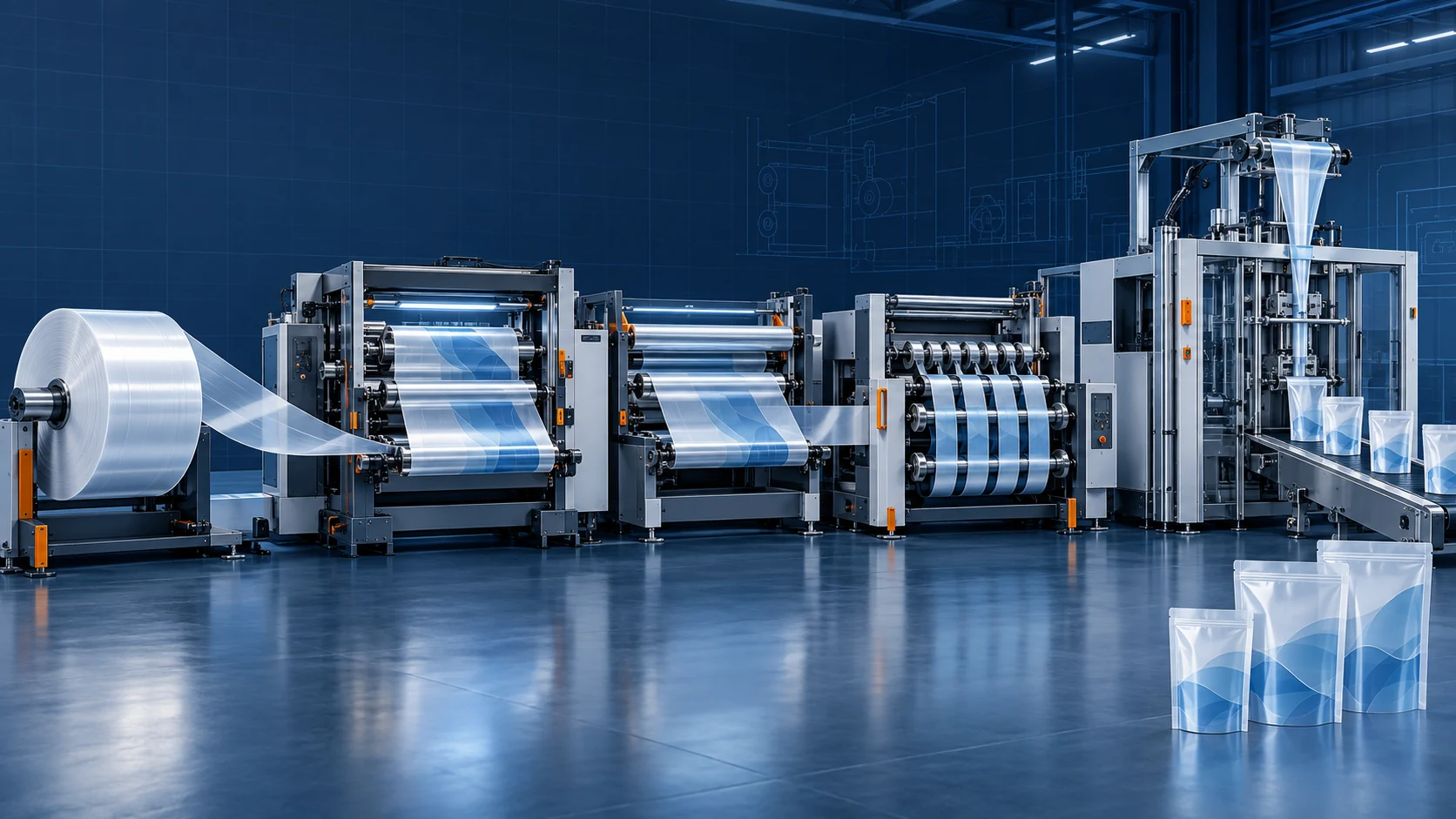
Mono-material flexible packaging is receiving more attention from brand owners, converters and regulators. Industry guidance increasingly encourages mono-PE and mono-PP structures where they can meet the required product-protection and recycling objectives.
That does not mean every package can be converted to a single-polymer structure by changing one film or one machine setting. A package still has to protect its contents, run reliably, seal correctly, print consistently and remain suitable for the collection and recycling system in its target market.
For machinery buyers, the practical question is therefore not simply, “Can this line run mono-material film?” A better question is:
Can the proposed process window produce the target package structure, quality and output consistently with the materials we intend to use?
The following checklist can help converters prepare a more useful discussion with extrusion, printing, lamination, slitting and bag-making equipment suppliers.
1. Define the finished package before discussing the machine
Start with the package rather than the equipment catalogue. Prepare the basic application information:
- product to be packed;
- target pack format and dimensions;
- filling and sealing method;
- required barrier and shelf-life objectives;
- storage, transport and climate conditions;
- printing and appearance requirements;
- target PE, PP or mixed-polyolefin structure;
- applicable market, customer and recycling-design requirements.
This information helps separate essential functions from features that may be changed during redesign. Product protection and safety should not be sacrificed merely to reach a simplified material description.
2. Map every component in the structure
“Mono-material” does not necessarily mean that every component is chemically identical. Inks, adhesives, coatings, barrier layers, tie layers, labels, zippers, valves and liners can all affect the final structure and its recycling compatibility.
Before requesting a machine proposal, prepare a layer-by-layer structure map. For each component, record its material, thickness or coating weight, function and supplier. Then compare the proposed structure with the relevant design-for-recycling guidance for the market where the pack will be sold.
CEFLEX and RecyClass publish detailed guidance for PE and PP flexible packaging. Their documents should be treated as technical references, not as a substitute for local compliance review or testing.
3. Confirm the extrusion and film-handling window
Mono-PE and mono-PP projects can involve different film stiffness, stretch behaviour, heat response, surface properties and gauge profiles. These differences influence more than the extrusion section. They can affect web transport throughout the converting line.
Questions to discuss with the equipment supplier include:
- What resin and film specifications will be used during the trial?
- What finished width and thickness range is required?
- How will thickness consistency be measured?
- What web-tension range is expected at each process stage?
- Are corona treatment or other surface-preparation steps required?
- Which measurements should be recorded during the trial?
Avoid asking for a universal “mono-material setting.” The useful output is a documented process window for the actual materials and package structure.
4. Review printing, coatings and ink coverage
Printing is part of the package structure, not only a graphic-design step. Ink systems, coverage levels, primers, overprint varnishes and drying conditions can influence appearance, converting performance and recycling compatibility.
The machinery discussion should cover:
- printing method and number of colours;
- substrate surface treatment;
- ink and coating system proposed by the material supplier;
- drying or curing requirements;
- register tolerance required by the package design;
- inspection method for print defects;
- how the printed web will behave in later lamination, slitting and sealing steps.
Any claim about recyclability should be confirmed against the complete printed structure, not an unprinted base film alone.
5. Treat lamination as a system decision
Some applications need barrier, stiffness, puncture resistance or sealing performance that a single film layer cannot provide. A mono-polymer family may still use multiple layers, coatings or adhesives to achieve the required function.
For the lamination stage, prepare the following information:
- full film and coating structure;
- adhesive or bonding system;
- target coating weight;
- curing requirements;
- line speed used for validation;
- temperature and tension limits;
- bond-strength test method;
- barrier and seal-performance test plan.
Do not select a dry, solventless or extrusion-lamination process from a sustainability label alone. The correct process depends on the package structure, materials, performance requirements and validated operating window.
6. Check slitting and rewinding stability
A structure that looks acceptable after printing or lamination can still create problems during slitting and rewinding. Curl, telescoping, blocking, loose edges and unstable tension can affect downstream bag making and customer use.
During a machinery trial, record:
- parent-roll and finished-roll dimensions;
- winding direction;
- target roll hardness;
- edge quality;
- tension profile;
- treatment of trim waste;
- roll condition after storage.
Use material from the actual proposed structure where possible. A trial with an easier substitute film may not reveal production problems.
7. Validate bag making and sealing with real product requirements
The bag-making stage connects material design with the final package. Seal temperature, dwell time, pressure, cooling and web tension need to work together. The acceptable window should be wide enough for stable production, not merely one successful sample.
Ask the supplier to agree on the test method before the trial. Depending on the application, the evaluation may include dimensional consistency, seal appearance, seal strength, leakage, drop performance or other customer-specified tests.
For PP woven packaging, also map any coating, printed film, liner, valve, sewing thread and closure component. A woven PP substrate by itself does not establish the recycling compatibility of the completed sack.
8. Request a documented line trial
A useful trial report should identify:
- material suppliers and exact material codes;
- roll and film specifications;
- machine configuration;
- operating settings;
- speed achieved during the stable trial period;
- quality measurements and acceptance criteria;
- defects observed and adjustments made;
- retained samples and final conclusions.
The objective is repeatability. A sample without traceable materials and settings is difficult to use for equipment comparison or factory acceptance.
Information to send before requesting a proposal
To receive a more relevant equipment recommendation, send the machinery supplier:
- Finished package drawing and dimensions.
- Product and filling method.
- Proposed material structure for every layer and component.
- Required output and working schedule.
- Printing, barrier and appearance requirements.
- Available factory space, utilities and local operating conditions.
- Trial materials and agreed acceptance tests.
The earlier these inputs are clarified, the easier it becomes to compare equipment configurations on the same basis.
Discuss your packaging process with Grace International
PINGYANG GRACE INTERNATIONAL TRADE CO., LTD. works with customers planning PP woven-bag and flexible-packaging machinery projects. Tell us your target package, material structure, required output and available factory space. Our team can help organise the information needed for a technical equipment discussion and line proposal.
Discuss Your Packaging Process
Send your target package, materials, output and factory requirements for a technical discussion.
Technical note: Recycling and regulatory requirements differ by market and application. Confirm the final package design with qualified material, testing, recycling and compliance specialists before commercial production.
Sources and further reading
- Flexible Packaging Association: Plastic Isn’t Disappearing, But It Is Being Re-engineered (September 7, 2026)
- European Commission: FAQ on the Packaging and Packaging Waste Regulation (August 3, 2026)
- CEFLEX Designing for a Circular Economy Guidelines (maintained guidance)
- RecyClass Design for Recycling Guidelines (updated March 11, 2026)
FAQ
Does mono-material packaging always use only one layer?
No. A mono-PE or mono-PP package may use several layers or films from the same polymer family and may also include inks, adhesives, coatings, barriers, closures or labels. The complete structure must be evaluated.
Is every mono-PE or mono-PP package recyclable?
Not automatically. Recyclability depends on the complete package design and on the collection, sorting and recycling infrastructure in the target market. Use the relevant market guidance and testing method.
Can an existing lamination machine run a redesigned mono-material structure?
It may be possible, but it cannot be assumed. The films, adhesive or coating system, tension range, drying or curing conditions, line speed and quality criteria must be checked through a controlled trial.
What samples should a buyer send for a machinery trial?
Send the exact proposed films, resin or woven substrate, inks, adhesives, coatings, closures and other components, together with a finished-package drawing and acceptance criteria.
What should be included in a machinery trial report?
The report should record material identities, machine configuration, operating settings, stable trial speed, measured quality results, observed defects, corrections and retained samples.
